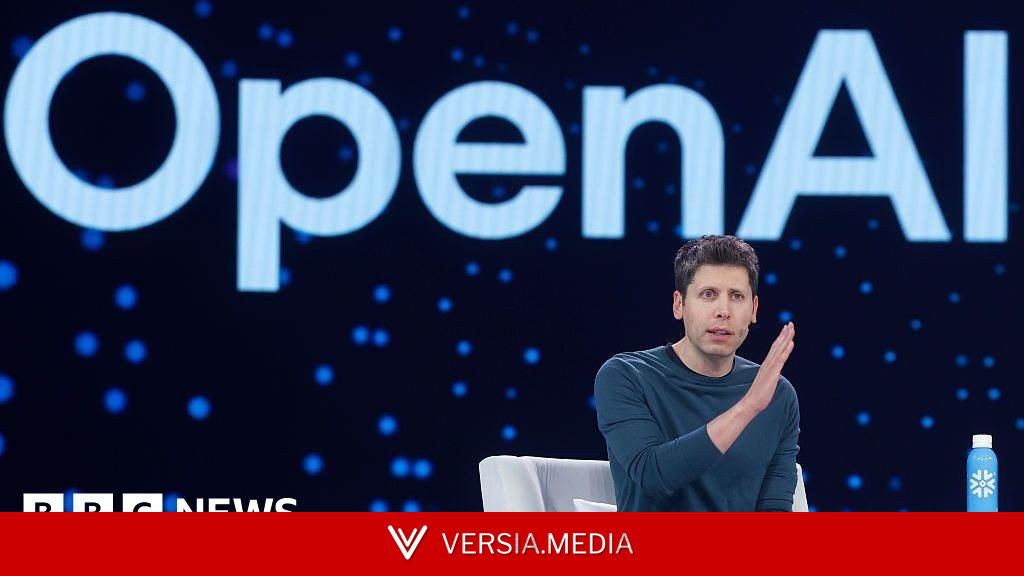
OpenAI, the creator of the widely used ChatGPT chatbot, has become the most recent major artificial intelligence (AI) firm to announce intentions to offer shares to the public via a stock market listing.
Its choice had been anticipated for several months, but the company's disclosure arrives precisely one week after competing AI business Anthropic revealed it was also preparing to go public.
On Monday, OpenAI stated it had submitted a confidential filing with the US Securities and Exchange Commission to pursue an initial public offering (IPO) at an undetermined future date.
Its strategies are part of a surge of significant IPOs, which also include Anthropic and billionaire Elon Musk's aerospace venture, SpaceX, scheduled to launch on the Nasdaq on Friday.
SpaceX is targeting a stock price that would place the company's valuation at $1.75tn (£1.3tn).
Revealing its IPO intentions on Monday, OpenAI remarked: "We have not set a timeline yet; it could take some time because there are initiatives we wish to pursue that are probably simpler as a private entity."
All three enterprises have a "significant need for cash," according to Sunil Krishnan from Aviva Investors, and "nobody wants to be last" in the race to go public, he informed the BBC's Today programme.
He noted that these firms are pouring substantial resources into their AI infrastructure, including chips, and training their AI models, all of which entail enormous costs.
OpenAI and Anthropic, the creator of the Claude chatbot, are concentrated on AI work and have been intense competitors essentially since Dario Amodei established the latter company five years ago.
He took that step after departing OpenAI due to disagreements with Sam Altman, the co-founder and chief executive of OpenAI.
Currently, the companies vie for users, corporate clients, and investors, and in recent months have been competing with private valuations approaching $1tn.
OpenAI's most recent valuation from private backers stood at $852bn. Anthropic's latest valuation reached $965bn.
The firms will now compete over which might make its debut on the public stock exchange first, as neither has specified an exact timeline for this event.
Investors are closely monitoring the listings of these two generative AI companies, as their performance will help set benchmarks for others to follow, stated assistant professor Richard Crowley from the Singapore Management University.
"We might typically view OpenAI and Anthropic as rivals, but the fortunes of their financing are closely linked through the public's perception of the generative AI sector," he said.
SpaceX's stock market launch could represent Musk's most significant risk yet
AI giant Anthropic intends to sell shares in the US as its valuation nears $1tn
Last week, Altman mentioned in a CNBC interview that he was not in a hurry to take OpenAI public, and that he would do so "when it is appropriate."
In its Monday statement, OpenAI explained it was disclosing its IPO plans because "we expect it to become known."
The company noted that revealing its intentions and its choice to go public "involves a complex set of compromises."
Having submitted the required documents for SEC review, the company says it now "has the ability to go public sooner if that proves to be the best path."
By listing on the stock market, OpenAI will be required to increase transparency regarding its financials and product development.
IPO listings can also discourage private investment and make transactions slower or less attractive because companies must reveal more information, Crowley noted.
For OpenAI, Anthropic, and SpaceX, which also owns the contentious AI chatbot Grok, selling shares to the public is likely to generate billions of dollars in capital.
One of the most expensive elements of operating an AI company is what is termed "compute," which generally refers to the infrastructure and processing capability needed to build, train, test, and then make its products, like a chatbot, available to the public.
OpenAI's compute expenses are estimated to exceed $100bn annually, while its revenue—the actual money it earns from its operations—represents only a small portion of that.
SpaceX is also far from being a profitable enterprise.
Anthropic, however, has informed investors that it anticipates becoming profitable in the first half of this year, as it reports that sales of its Claude product and associated services have experienced substantial growth.
Additional reporting by Osmond Chia